- Apr 29
Ten Trillion Dollars
- Gabriel Campillo
What I told 250 CEOs at Porto Business School about the hidden tax on every business — and the 200-year-old hangover that explains it.
Last month I gave a keynote to 250 CEOs at Porto Business School. I opened with a single number.
Ten trillion dollars.
That's the cost, every year, of disengaged employees globally. According to Gallup's State of Work 2026, employee engagement has
fallen to 20%. Roughly 9% of global GDP — gone. Not invested poorly. Not lost to inflation. Just bled out, year after year, because most companies still don't know what to do about it.
The Portugal numbers from the same report are sharper:
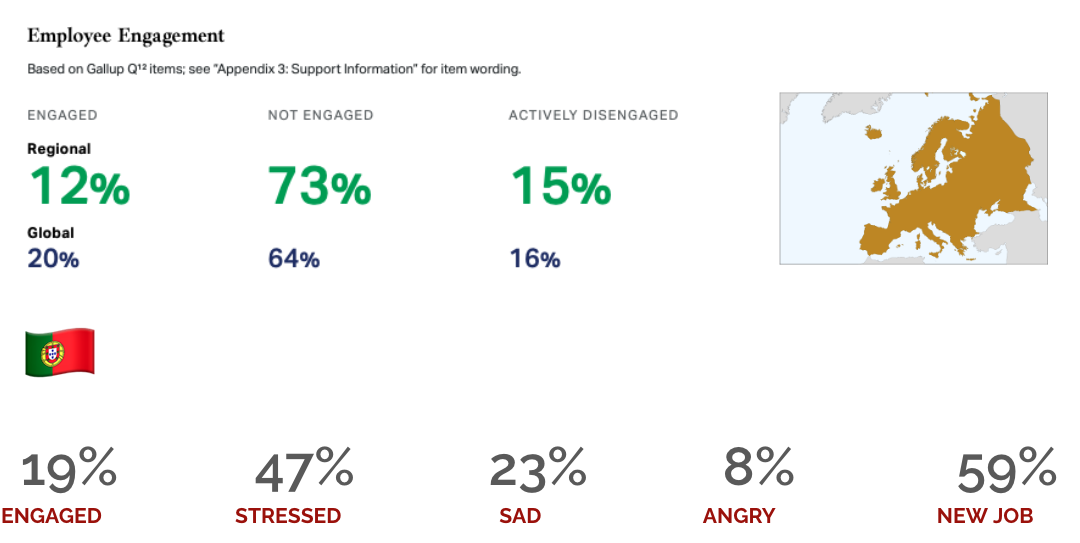
And before anyone in the Porto room could file this away as an HR problem, I told them: it isn't.
It's a leadership problem with a 200-year-old root cause.
Modern management was engineered between 1819 and the 1950s. Frederick Taylor. Henri Fayol. The railroads. The assembly line.
Tools built for a specific job: running things that already exist. Reports. Forecasts. Stage-gates. Risk committees.
We are still using those tools. Almost unchanged. In 2026!
Which means we're trying to lead 21st-century knowledge workers, inside companies facing exponential disruption, with a management operating system designed for 19th-century factory floors.
The cost shows up as disengagement on the people side. And as dead innovation projects on the business side. Because here's the part most leaders don't see: business management culture kills innovation. It acts as a corporate immune system.
It blocks new ideas.
It maintains the status quo.
It protects the already-proven business model.
It works in silos.
It treats every new idea as if it were a mature business model that needs to defend
itself with data, when by definition, it can't yet.
The same management OS that's draining $10 trillion from global productivity is also strangling every innovation project that
crosses your desk.
Here's the case. A global stainless steel, $7B revenue, the kind of legacy industrial business everyone assumes is "too slow to innovate." We ran an 18-week Innovation Sprint with 45 of their senior people. €150,000 invested.
The output: a defensible, new digital business model and new revenue line targeting $10M over 2-3 years, owned by their own team.
Why did it work? Not because the Company suddenly hired better managers. Because we stopped trying to manage innovation and
started leading it. Different discipline. Different toolkit. Different operating system.
That's the gap I'm closing. Here's what to do this week, if any of this lands:
Take twenty minutes. Open your last three innovation initiatives the ones that died, the ones that stalled, the one that's still limping.
Ask: did the corporate immune system kill them? Were they treated as new ideas needing room to breathe, or as half-formed business models forced to defend themselves against backward-looking data?
Be honest. The honest answer is the diagnosis.
If you want the structured version of this, the one I walked the Liderteam room through, I built it into a 6-page document called The Innovation Leadership OS. It's the one-page operating system behind everything we just talked about. MTP, North Star Metric, 3-Horizon portfolio, the diagnostic frame.
Free. No upsell. Built to be filled in, not shelved.
Get it here: https://www.whitespace.academy/the-1-page-innovation-strategy
Page 6 has my calendar if you want a 90-minute working session on it. Otherwise read it, fill it in, and watch the diagnosis
change the conversation in your next leadership meeting.
The next 200 years won't be led by better managers. They'll be led by people who finally learned the difference.
All good things,
Gabriel